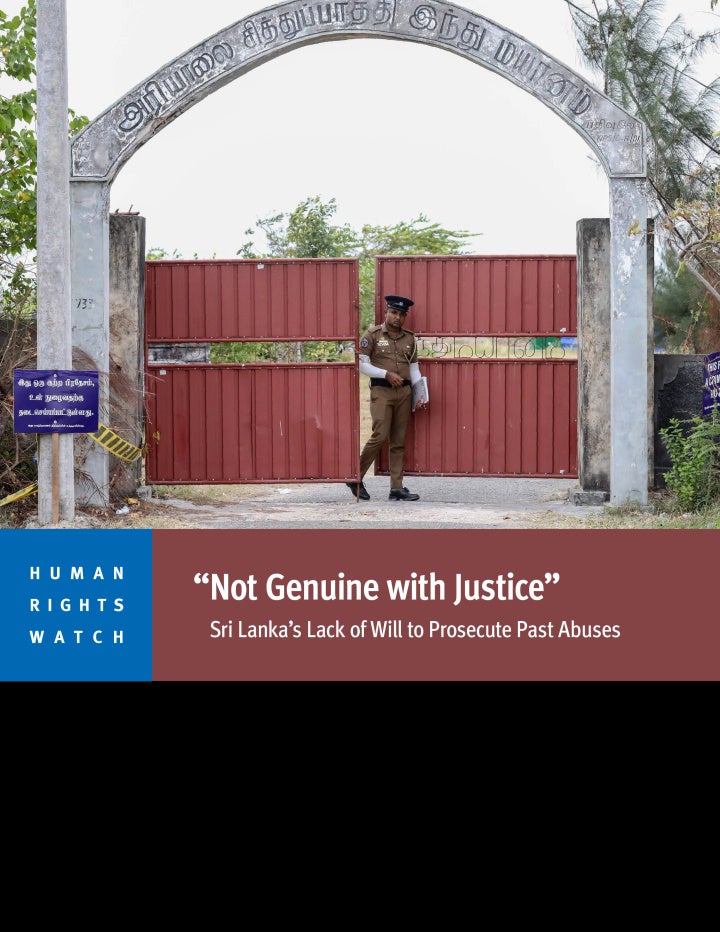
The 49-page report, “‘Not Genuine with Justice’: Sri Lanka’s Lack of Will to Prosecute Past Abuses,” provides an overview of domestic justice efforts in seven prominent cases of grave abuses in which the Dissanayake government has made a measure of progress since taking office in 2024. Human Rights Watch found that many emblematic cases, including a massacre of aid workers, the targeting of journalists, and enforced disappearances of academics and others, remain stalled, while families of victims and human rights defenders face threats and intimidation.
In May 2006, Human Rights Watch released its initial paper on the functions of the new Human Rights Council (HRC), focusing on universal periodic review (UPR), country situations, and the review of special procedures. In the ensuing months, numerous member states, nongovernmental organizations (NGOs), and leading scholars have offered proposals for how the UPR should be conducted.
In this brief initial paper, Human Rights Watch seeks to contribute to the ongoing discussions about how the Human Rights Council should function and develop its work. The first year of the Council will be one of transition, but also a unique occasion to build a principal human rights organ that delivers results in the short, medium, and long term.
This briefing paper addresses the need for the U.N. Security Council to authorize the proposed United Nations mission in Darfur to use force as necessary to protect civilians.
Impunity and Human Rights Abuses in Northern Uganda
This 76-page report documents how the ongoing lack of accountability and civilian protection in the north has fueled atrocities by both sides. In each of the displaced persons camps visited, Human Rights Watch found cases of abuse by Ugandan government forces as well as rebel combatants.
Consolidation of Ethnic Cleansing in Darfur, Sudan
This report documents the continuing climate of violence and insecurity in Darfur, and the urgent need for an expanded international protection force, especially near the camps that hold many of Darfur’s 1.6 million displaced persons. Just this week, as the U.N. Security Council prepared to meet in Nairobi, Sudanese security forces brazenly overran camps for the displaced persons.
This 56-page report evaluates developments at the court, identifying achievements and making recommendations where operations should be improved. The report also urges the international community to provide more financial and political support for the court so it can complete its work effectively.
The U.N. Security Council's Approach to Human Rights Violations in the Global Anti-Terrorism Effort
This 17-page briefing paper documents how countries as diverse as Egypt, Uzbekistan, Malaysia, Morocco and Sweden—have violated human rights in their efforts to combat terrorism. These are the very kinds of violations that the U.N. Counter-Terrorism Committee should pay closer attention to.
Since the establishment of the Government of National Unity in Kinshasa in June 2003, peace has eluded eastern parts of the Democratic Republic of Congo (DRC), particularly in Bukavu and the wider Kivu region, Ituri and Northern Katanga.
The current dire humanitarian crisis in Darfur has been caused by massive, systematic violations of international human rights and humanitarian law constituting crimes against humanity committed by the Sudanese Government and its ethnic militia, the Janjaweed.
In the ten years since the Rwandan genocide, leaders of national governments and international institutions have acknowledged the shame of having failed to stop the slaughter of the Tutsi population. Halting any future genocide will require not just exerting greater political will than seen in the past, but also developing a strategy built on the lessons of 1994.
Human Rights Watch has received information about human rights abuses against Dalits in virtually every sphere of life in Nepal, including marriage, religious practice, access to land, and access to education. This submission to the government’s 15th and 16th periodic report to the Committee documents continued conditions of oppression and abuse.
The Commission on Human Rights should adopt a resolution encouraging the Democratic Republic of Congo (DRC) to implement reforms in its judicial system and to begin investigation and prosecution of violations of international law committed during the recent wars (beginning in 1996 and 1998 respectively).
This briefing paper analyzes the new peace plan in the light of previous Israeli-Palestinian agreements – all of which fatally ignored basic human rights and international humanitarian law protections. Instead, the plans let abuses proliferate to the point where they undermined the entire negotiating process.
The draft agreement between the United Nations and the Cambodian government for the establishment of a "mixed tribunal" based in Cambodia is deeply flawed.