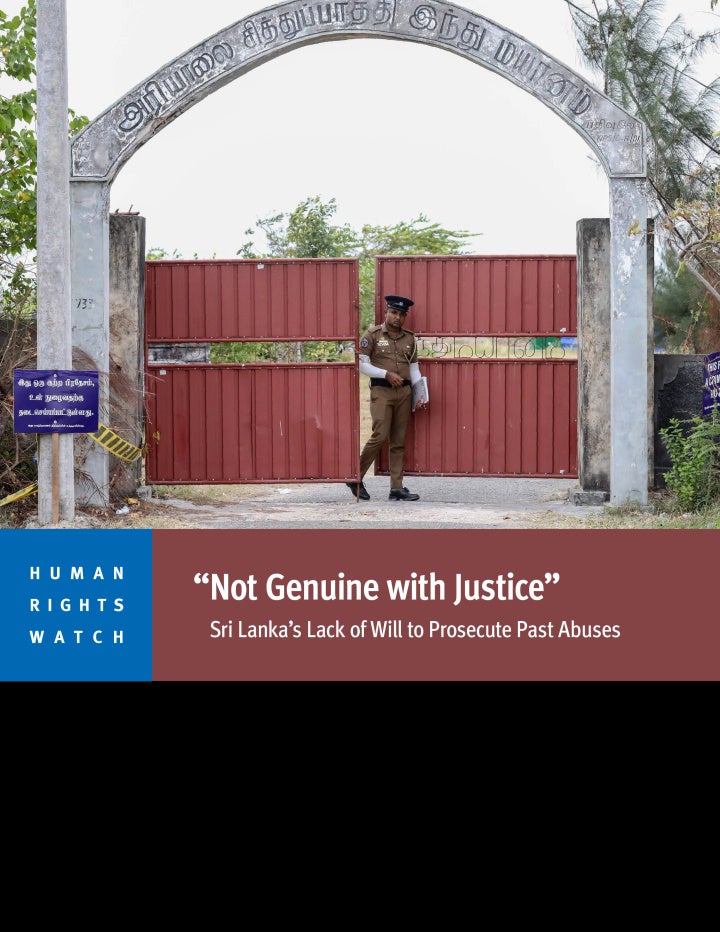
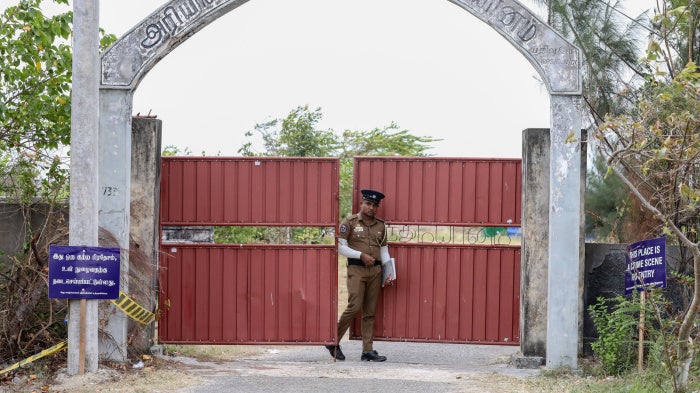
The 49-page report, “‘Not Genuine with Justice’: Sri Lanka’s Lack of Will to Prosecute Past Abuses,” provides an overview of domestic justice efforts in seven prominent cases of grave abuses in which the Dissanayake government has made a measure of progress since taking office in 2024. Human Rights Watch found that many emblematic cases, including a massacre of aid workers, the targeting of journalists, and enforced disappearances of academics and others, remain stalled, while families of victims and human rights defenders face threats and intimidation.
Briefing to the 59th Session of the UN Commission on Human Rights
Human Rights Watch calls on the U.N. Commission on Human Rights to condemn the execution of juvenile offenders in those few states that retain the practice in an omnibus children's resolution, a resolution on extrajudicial, arbitrary and summary executions, and any resolution on the death penalty.
Refoulement, Militarization of Camps, and Other Protection Concerns
The United Nations Security Council should extend the arms embargo on Liberia to all rebel groups, and closely monitor the compliance of the Guinean government with that embargo, Human Rights Watch said today. The Guinean government’s close relationship with Liberian rebel groups is posing a serious threat to refugees’ security and protection in Guinea.
As Afghan and United Nations officials prepare for the forthcoming loya jirga (grand national assembly), as called for in the 2001 Bonn Agreement to choose Afghanistan's next government, ordinary Afghans are increasingly terrorized by the rule of local and regional military commanders - warlords - who are reasserting their control over large areas of Afghanistan.
In this briefing paper, Human Rights Watch builds on the U.N. experts’ report to examine the manner in which the Liberia arms embargo has been systematically breached to furnish weapons to gross human rights abusers. Much attention has been given in the past to the subject of individual arms traffickers and the transport networks they use to illegally deliver weapons to abusive end users.
State-sponsored national human rights commissions represent a new vogue among governments, and particularly in Africa. The number of state human rights commissions has multiplied across the continent in the past decade, spreading from one country in 1989 to two dozen by 2000.
On April 18, the United Nations Security Council will debate the U.N. Panel of Experts report on the sanctions regime against the rebels of the National Union for the Total Independence of Angola (UNITA), which was submitted to the Security Council on February 28. The Security Council is expected to issue a resolution that will shape the future of the sanctions regime in Angola.
Sierra Leonean refugee children in Guinea are among the most vulnerable children in the world. They have lived through an extremely brutal war -most have witnessed or suffered unspeakable atrocities including widespread killing, mutilation, and sexual abuse.
In a report released today, Human Rights Watch condemns the war of terror now underway against civilians in Sierra Leone, and calls on the international community to take emergency measures to end the killings, amputations, and abductions taking place in that civil war.
The United Nations Operation in the Western Sahara
In 1988, both Morocco and the Polisario Front agreed to a United Nations Settlement Plan. After sixteen years of war, a cease-fire formally took effect in the Western Sahara in September 1991. In August 1995, Human Rights Watch conducted a fact-finding mission to Tindouf, Algeria and to Laayoune, the capital of the Western Sahara.
Recycled Haitian Soldiers On the Police Front Line
The United States-dominated multinational force entered Haiti on September 19, 1994, with a mandate to "use all necessary means...to establish and maintain a secure and stable environment...." The force's presence permitted the reinstatement of President Jean-Bertrand Aristide and a reduction in the severe human rights abuses that plagued Haiti during the three year military regime.