The Inhumane Effects of White Phosphorus Munitions and the Need for Stronger Law
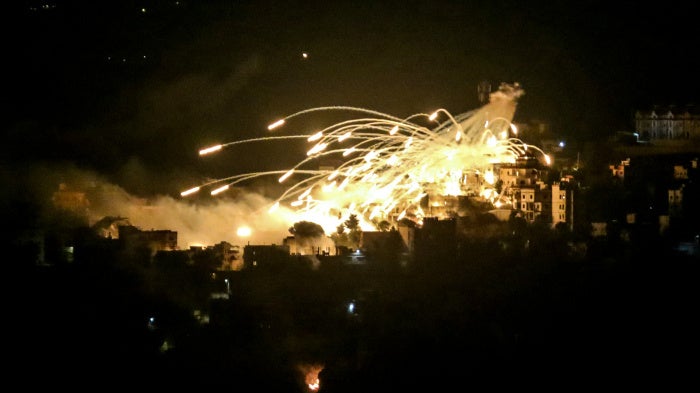
The 45-page report, “Uncontrolled Burn: The Inhumane Effects of White Phosphorus Munitions and the Need for Stronger Law,” documents 23 verified incidents of Israeli use in southern Lebanon between March and May 2026. The report also details the horrific harm the munitions have caused in armed conflicts in recent years. White phosphorus munitions, which produce fire when their payload is exposed to oxygen, are not currently regulated by a specific treaty.
The current crisis in Sierra Leone, in which rebels with the Revolutionary United Front (RUF) have clashed with U.N. peacekeepers and pro-government forces, suggests that the fragile peace agreed to in July 1999 is rapidly unraveling.
Nearly four years ago, in May 1996, the United States began a search for alternatives to antipersonnel landmines so that the U.S. military could completely eliminate their use "as soon as possible." A little more than a year later, a target date of 2006 was established for fielding alternatives, thus permitting the U.S. to join the 1997 Mine Ban Treaty (Ottawa Convention) at that time.
On December 27, 1999, Interfax reported Russian forces were using fuel-air explosive bombs in the fighting in Chechnya.(1) The use of fuel-air explosives (FAEs), popularly known in Russia as "vacuum bombs," represents a dangerous escalation in the Chechnya conflict--one with important humanitarian implications. FAEs are more powerful than conventional high-explosive munitions of comparable size, are more likely to kill and injure people in bunkers, shelters, and caves, and kill and injure in a particularly brutal manner over a wide area. In urban settings it is very difficult to limit the effect of this weapon to combatants, and the nature of FAE explosions makes it virtually impossible for civilians to take shelter from their destructive effect.
This report shows that military support for paramilitary activity remains national in scope, and includes areas where units receiving or scheduled to receive U.S. military aid operate. The report relies on Colombian government documents and extensive interviews with government investigators, refugees, and victims of political violence.
This report has the limited goal of assessing the number of civilian deaths from NATO attacks, as a step toward assessing NATO forces' compliance with their obligation to make protection of civilians an integral part of any use of military force. The benchmarks to be used for judging NATO's attacks are those of international humanitarian law, also known as the laws of war.
For the last two years, the government of Bulgaria has pledged to control the country's notorious arms trade as part of its strategy to join the North Atlantic Treaty Organization (NATO) and the European Union (E.U.). Sofia has taken important steps toward reform, but further improvements are urgently needed to ensure that the legacy of irresponsible weapons dealing is put to rest.
The announcement by the U.S. Defense Department at the end of April of a move toward the use of more Aarea weapons in Operation Allied Force, and the reports of a growing shortage of precision-guided weapons, point to an increased use of unguided (dumb) weapons by North Atlantic Treaty Organization (NATO) forces in the war against Yugoslavia, including so-called cluster bombs.
The U.S. Defense Department at the end of April announced a move toward the use of more "area weapons" in Operation Allied Force. At the same time, there are reports of NATO's growing shortage of precision-guided weapons. These factors suggest NATO may increasingly rely on unguided ("dumb") weapons, including so-called cluster bombs.
Bulgaria has earned a reputation as an anything-goes weapons bazaar where Kalashnikov assault rifles, mortars, antitank mines, ammunition,explosives and other items are available for a price — no matter who the buyers are or how they might use the deadly wares.
As the North Atlantic Treaty Organization (NATO) celebrates its 50th anniversary and welcomes its three new members—the Czech Republic, Hungary, and Poland—one of the likely consequences of the Alliance’s enlargement eastwards remains largely unexplored: a firesale of stocks of old weapons.
The U.S. Army and Antipersonnel Mines in the Korean and Vietnam Wars
Most of the world is poised to ban antipersonnel landmines, the indiscriminate weapons that kill or maim an estimated 26,000 civilians each year. More than 100 governments have committed to negotiating a comprehensive ban treaty in Oslo, Norway in September, with the intention of signing the treaty in Ottawa, Canada in December.
U.S Companies and the Production of Antipersonnel Mines
Despite the Clinton Administration's attempts to lay claim to the mantle of global leadership in the effort to ban antipersonnel landmines, the United States has refused to ban or even formally suspend the production of antipersonnel mines. From 1985 through 1996, the U.S. produced more than four million new antipersonnel mines.
Human Rights Watch has uncovered evidence that the Yugoslav National Army (JNA) had an extensive and sophisticated chemical weapons program prior to the breakup of Yugoslavia in 1991; that the army of the Federal Republic of Yugoslavia (Serbia and Montenegro) inherited much of this program; and that the army of the Republic of Bosnia and Hercegovina produced crude chemical munitions during the Bos
Laws of War Violations and the Use of Weapons on the Israel-Lebanon Border
For over a decade, a conflict has raged on the border of Israel and Lebanon, where Israel occupies a large section of Lebanese territory. Civilians have been the principal targets and victims in this conflict.
Arms Trade and Human Rights Abuses since the Lusaka Protocol
In updating our 1994 report, Arms Trade & Violations of the Laws of War in Angola, we found that despite the signing of the Lusaka Protocol between the Angolan government and UNITA that led to a cease-fire, sporadic fighting continued in 1995.