Reports

The Inhumane Effects of White Phosphorus Munitions and the Need for Stronger Law

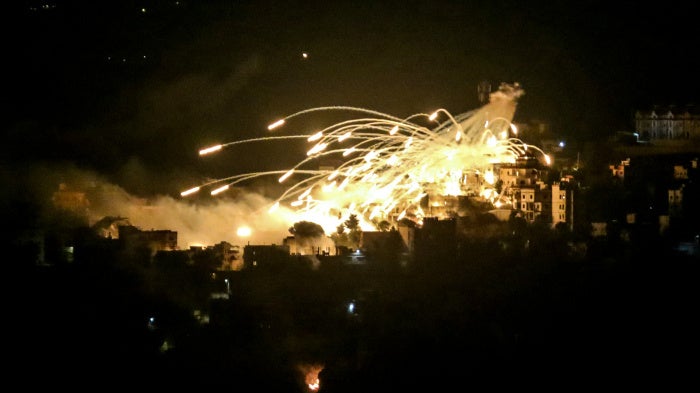
The 45-page report, “Uncontrolled Burn: The Inhumane Effects of White Phosphorus Munitions and the Need for Stronger Law,” documents 23 verified incidents of Israeli use in southern Lebanon between March and May 2026. The report also details the horrific harm the munitions have caused in armed conflicts in recent years. White phosphorus munitions, which produce fire when their payload is exposed to oxygen, are not currently regulated by a specific treaty.

A white phosphorus munition airbursts over buildings in the town of Khiam in southern Lebanon during an Israeli bombardment on October 31, 2024.
A man holds a flower and the message "Humanity for All" in front of a line of soldiers

Search

  • November 1, 1995

    Since 1984, the government of Turkey has waged an increasingly bitter war with insurgents of the Kurdistan Workers Party (PKK). To date, the toll is estimated at over 19,000 deaths, including some 2,000 death-squad killings of suspected PKK sympathizers, two million internally displaced, and more than 2,200 villages destroyed mostly by Turkish security forces. In an effort to root out PKK fighters and sympathizers from southeast Turkey, the government has adopted increasingly brutal counterinsurgency measures, in clear violation of international law. The PKK, for its part, has also systematically engaged in violations such as summary executions and indiscriminate fire.This report documents the Turkish security forces’ violations of human rights, and their reliance on U.S. and NATO-supplied weapons in doing so. Drawing on investigations of some 30 incidents that occurred between 1992 and 1995, the report links specific weapons systems to individual incidents of Turkish violations. Supplemented by interviews with former Turkish soldiers, U.S. officials and defense experts, the report concludes that U.S. weapons, as well as those supplied by other NATO members, are regularly used.
  • May 1, 1995

    The U.S. has pursued the development of at least 10 different tactical laser weapons that have the potential of blinding individuals. The existence of most of these programs is not known to the American public, Congress, or even throughout the military, and services responsible for laser weapons seem largely unaware of the programs in research and development in other services.
  • March 1, 1995

    Although the United Nations peacekeeping mission in Cambodia has been hailed as one of the mostsuccessful ever, the country was back at war even before the last of the peacekeepers left. The civilian population now faces a wide range of abuses from both the Khmer Rouge and the Royal Cambodian Armed Forces.
  • December 1, 1994

    We issued this report upon learning of a tense debate within the U.S. State and Defense Departments over whether to allow the export to Turkey of the most advanced and deadly cluster bomb in the U.S. arsenal, the CBU-87. Those who oppose the sale based on Turkey’s appalling human rights record are squared off against those who fear damage to the “strategic relationship” if the sale is denied. The CBU-87’s “combined effect” is its ability to be used both as an antitank and antipersonnel weapon. The CBU-87 could be used in Turkey’s counterinsurgency war with Kurdish rebels, with dire consequences for the civilian population, as the Turkish government has a well-documented record of contempt for civilian life during military operations.
  • November 1, 1994

    Angola’s “forgotten war,” fueled by a steady supply of weapons to both sides, has claimed an estimated 100,000 civilian lives since the conflict resumed following the September 1992 elections. The government and the UNITA rebels are responsible for an appalling range of violations of the laws of war.
  • September 1, 1994

    The massive proliferation of small arms and light weapons in South Asia is directly linked to the Soviet invasion of Afghanistan in 1979, and the subsequent creation by the United States of a system, commonly known as the Afghan pipeline, to funnel weapons covertly to the Afghan resistance.
  • March 1, 1994

    In spite of the peace accord signed in October 1992 between government forces and RENAMO rebels, innocent civilians are maimed and killed by landmines in Mozambique on a daily basis.
  • January 1, 1994

    The Arms Trade and Human Rights Abuses in the Rwandan War

    On October 1990, the Rwandese Patriotic Front launched an invasion from neighboring Uganda, aimed at overthrowing the Rwandan government. While the war has stopped in an uneasy peace, an estimated 4,500 people died in the conflict and nearly one million civilians are refugees.
  • January 1, 1993

    Landmines have rendered large areas of arable land and pasture, many roads, bridges, river banks, villages, and some important economic installations unfit for the people of Angola.
  • June 1, 1992

    Landmines and Civilian Casualties in Iraqi Kurdistan

    Decades of internal conflict with the Kurds and another nine years of international strife — first with Iran and then with the U.S.-led coalition — have left much of northern Iraq littered with millions of unexploded landmines.
  • June 1, 1991

    Civilian Casualties During the Air Campaign and Violations of the Laws of War

    This report applies the rules of war governing international armed conflicts to examine civilian casualties and damage to civilian objects from bomb and missile attacks carried out by the allied forces against Iraq during Operation Desert Storm, and from missile attacks by Iraq against Israel, Saudi Arabia, Bahrain and Qatar.
  • March 6, 1991

    Middle East Watch Condemns Bombing Without Warning Of Air Raid Shelter In Baghdad's Al Ameriyya District On February 13

    The purpose of this newsletter, the fourth released by Middle East Watch since January 17, is to provide information and analysis concerning compliance by the U.S. and coalition forces under its command with binding restraints on methods and means of combat as they apply to the conduct of air warfare.