Systemic Age and Gender Discrimination Against Women at Work in South Korea
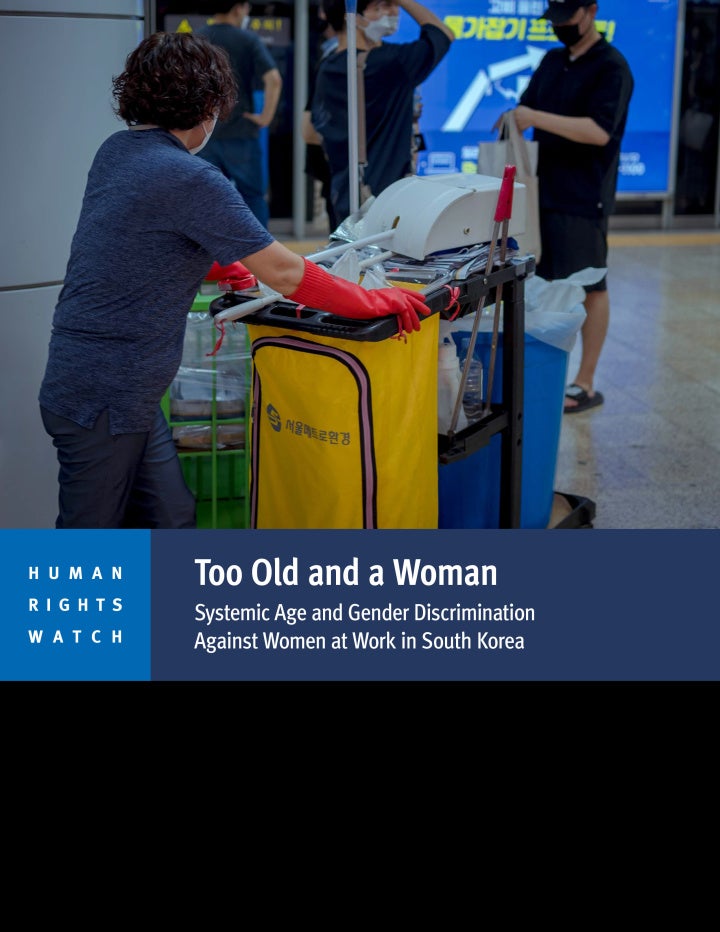
The 92-page report, “Too Old and a Woman: Systemic Age and Gender Discrimination Against Women at Work in South Korea,” documents that social attitudes toward education, unfair treatment in hiring, disrupted careers due to family responsibilities, limited promotion opportunities, glass ceilings, and sexual harassment create a disadvantage for South Korean women throughout their working lives. As women get older, their work opportunities narrow to a handful of low-paid, insecure jobs, and the gender pay gap increases. By the time they are eligible for pensions, women face a significant gender pension gap.
The briefing paper details some of the glaring deficiencies in current US labor law that significantly impair the right of workers to freely choose whether to form a union. It recommends that the US Congress pass the Employee Free Choice Act to help remedy these shortcomings and bring US law closer to international standards.
A Way Forward for Workers’ Rights in US Free Trade Accords
This 36-page report provides a roadmap for a new US administration to strengthen the requirements for workers’ rights in these agreements and to improve their enforcement. The Human Rights Watch report outlines in detail elements needed to effectively guarantee labor rights.
This 53-page report was jointly prepared by Human Rights Watch and the Center for Human Rights and Global Justice. It illustrates how everyday business decisions have significant implications for the human rights of workers, local communities, suppliers, and consumers.
Annex 22-B: A Missed Opportunity on Workers’ Rights in North Korea
This 13-page briefing paper looks at Annex 22-B of the US-Korea Free Trade Agreement (FTA) and how it flouts the spirit of the recently amended workers’ rights provisions. It also makes recommendations on how to amend Annex 22 in order to effectively protect, in law and practice, the basic labor rights of the workers producing goods under the existing agreement.
On May 10, 2007, congressional leaders and the US Trade Representative (USTR) reached an historic agreement on a “new trade policy template” (template) that has the potential to be an important step towards ensuring that workers’ rights are better protected in US trade accords.
Wal-Mart's Violation of US Workers’ Right to Freedom of Association
In this 210-page report, Human Rights Watch found that while many American companies use weak US laws to stop workers from organizing, the retail giant stands out for the sheer magnitude and aggressiveness of its anti-union apparatus. Many of its anti-union tactics are lawful in the United States, though they combine to undermine workers’ rights. Others run afoul of soft US laws.
Indonesia’s military has a longstanding practice of raising independent income outside the approved budget process. It earns funds from businesses it owns, services it provides for hire, and the protection rackets it operates.
The Human Rights Impact of Local Government Corruption and Mismanagement in Rivers State, Nigeria
This 107-page report details the misuse of public funds by local officials in the geographic heart of Nigeria’s booming oil industry, and the harmful effects on primary education and basic health care. The report is based on scores of interviews in Rivers state with government and donor agency officials, civil servants, health care workers, teachers, civil society groups and local residents.
While some governments have already started making meaningful reforms to help domestic workers work in greater safety and dignity, others are pursuing superficial changes that fail to address the root causes of exploitation and abuse. Governments around the world have choices to make about the route they will take; this essay identifies some of the positive options available.
The Human Rights Cost of the Indonesian Military’s Economic Activities
This 136-page report is the most comprehensive account to date of the harmful effect on civilians of the armed forces' involvement in business. Human Rights Watch calls on the Indonesian government to ban all military businesses, reform the budget process, and hold military personnel accountable for crimes.
In September 2003 and September 2004, Human Rights Watch argued for partial or total suspension of tariff benefits when we submitted Andean Trade Preferences Act (ATPA) petitions to the Office of the U.S. Trade Representative (USTR). In those petitions, we detailed Ecuador’s failure to meet the ATPA and ATPDEA workers’ rights criteria.
Written Testimony Submitted to the U.S. House of Representatives Committee on Ways and Means
Human Rights Watch welcomes the opportunity to testify regarding workers’ human rights under the proposed United States-Dominican Republic-Central America Free Trade Agreement (D.R.-CAFTA). Human Rights Watch takes no position on free trade per se, but we take an active interest in workers’ human rights.
The potential future dangers of widespread production and continued proliferation of cluster munitions demand urgent action to bring the humanitarian threat under control. At least seventy countries stockpile cluster munitions and the aggregate number of submunitions in these stockpiles is staggering.
Human Rights Watch welcomes this opportunity to present views regarding whether Ecuador meets the eligibility criteria of the Andean Trade Promotion and Drug Eradication Act (ATPDEA). These criteria include those in the original Andean Trade Preferences Act (ATPA), as well as those added in the ATPDEA, which extended and expanded the ATPA in 2002.