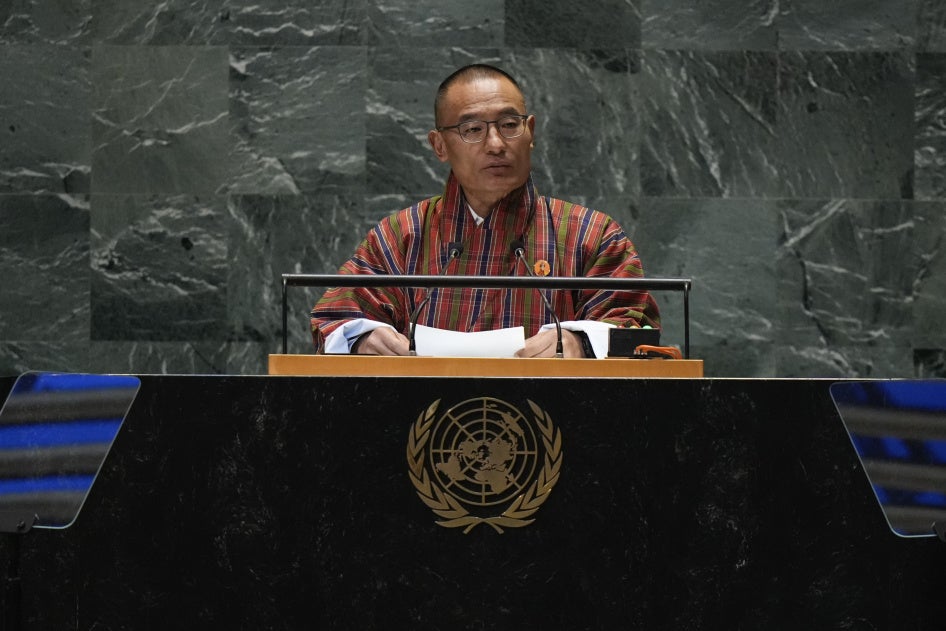
When Bhutan’s Prime Minister Tshering Tobgay meets world leaders at the United Nations general assembly in New York this week, they should urge him to release the at least 28 political prisoners who are still held in dreadful conditions in his country’s jails.
The small Himalayan kingdom projects itself to the world as the land that invented “gross national happiness,” but that image is belied by its detention and treatment of political prisoners.
Most are from the country’s Nepali-speaking community, and their cases relate to a period of rights violations that the community faced in the early 1990s. They were allegedly tortured before being convicted of terrorism and treason offenses at trials during which they had no defense lawyers. Most are serving sentences of life without parole.
Four of the prisoners belong to the Sharchop ethnic community and were accused of membership of the Druk National Congress, a banned political party that existed before Bhutan introduced democratic reforms in 2008.
In June, after the UN Working Group on Arbitrary Detention reviewed their cases, Bhutan released Chatur Man Tamang, 42, and Hasta Bahadur Rai, 44. They were serving life sentences since 2008, when they returned to the country as members of the Bhutan Communist Party to campaign for the rights of fellow Nepali-speaking Bhutanese refugees.
Their release showed how easily and swiftly Bhutan could free the remaining prisoners. Among those still being held, 11 were convicted in nearly identical cases to Tamang and Rai’s.
The prisoners are held in deplorable conditions, mostly in the “anti-national wing” of Chemgang prison near Bhutan’s capital Thimphu, or at Rabuna, a secretive and remote military prison. Former prisoners have described to Human Rights Watch how the men held at Chemgang have meage rations, little medical care, and no warmth in winter. They are denied communications with their families outside the country.
The Working Group on Arbitrary Detention and other UN rights experts have found that their detention is in breach of international human rights standards.
Bhutan should end these rights violations now and release all 28 of the remaining political prisoners. And until it does, international partners should make clear they are not buying the kingdom’s glossy sales pitch.